Sacred bottles and liquid identity: a dive into the portable faith of the Marche
Small, shiny, powerful. The holy water bottles of Loreto are more than a sacred object: they are a Marchigian icon. Between spirituality, tradition, and a sense of belonging, they hold a tradition that smells of home and everyday miracles.
Picture that tiny, semi-transparent object, containing water that seems ordinary but has carried, for generations, an aura of salvific power.
Exactly: the holy water bottle of Loreto.
One of those elements of the Marchigian domestic landscape you find everywhere: in grandmothers’ bags, in the dresser drawer, in the car next to the Madonna with the rosary, in the kitchen caddy.
And often it has never been opened. But it’s there.
Like an invisible password to feel protected, loved, and part of something.
Water that blesses, object that unites
Going to Loreto “to get the blessed water” is not just an act of faith. It’s also a family ritual, a collective journey, one of the first “spiritual trips” of life. Usually, you go with your grandmother, aunt, or your grandmother’s friend. And you return home with two bags: one for yourself, the other for “those who couldn’t come.”
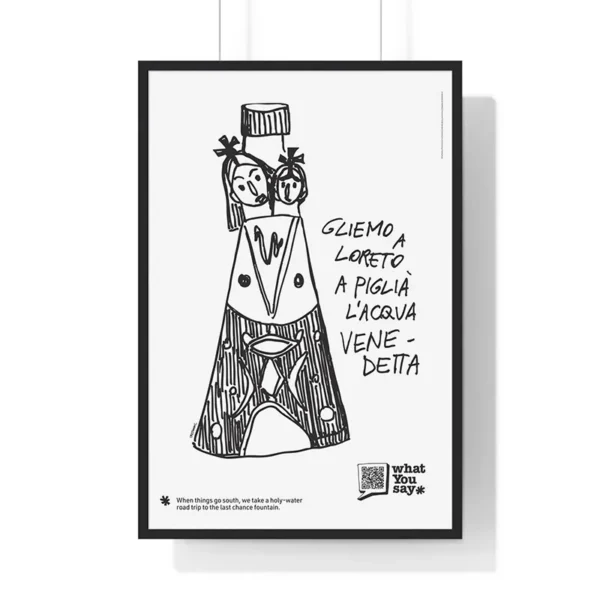
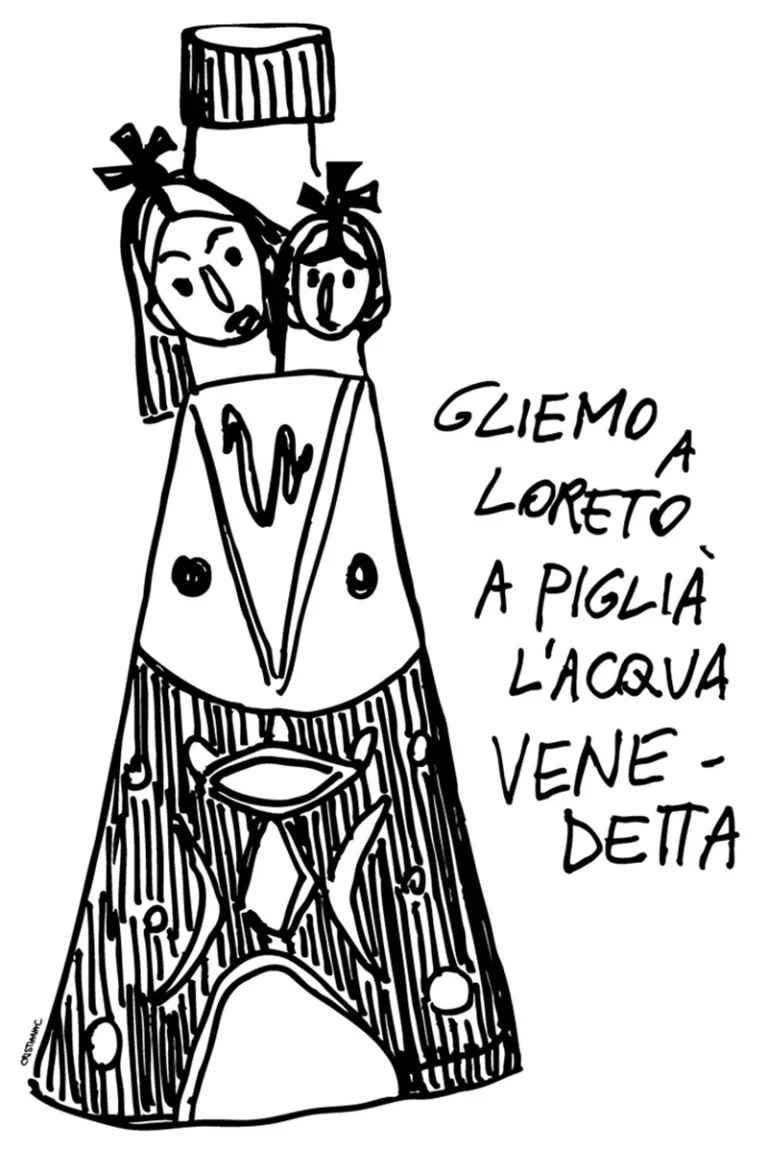
But beyond the religious value, there is a symbolic power in these small bottles. A precise, essential design, always the same. The Black Madonna with the Child. The screw cap. The body often decorated with glitter, reliefs, stars, hearts. An aesthetic between sacred art and popular kitsch.
Pocket-size devotion, full-size belonging
As our punk-inspired fictional translation puts it: “Pocket-size devotion, family-size belonging.”
Because these bottles don’t just bless spaces:
they bless bonds.
Between those who stayed and those who left, between believers and non-believers, between the sacred and the profane.
An object-bridge between memory, home, and local culture.
A gesture, a legacy
If faith is measured in gestures, then the holy water of Loreto is a gesture that lasts.
It remains in hands, pockets, wallets, and cupboards.
A timeless souvenir, needing no words. Just say:
“Let’s go to Loreto.”
And everyone knows what you mean.
Holy water, liquid culture
With this illustration, MarcheLove celebrates the bottle not just as a devotional object, but as a liquid symbol of Marchigian identity.
Small, seemingly fragile, yet extremely powerful.
Like dialect, like childhood, like belonging.
And then there’s Lu Sandinu
It’s not just a holy card: it’s a pocket-sized talisman, the first form of Marchigian multipass, the original wallet-sized protection.
Grandmothers would slip them everywhere: in wallets, among the pages of prayer books, in coat pockets, in the car, even in bedside tables and kitchen drawers. Wherever there was a small space, a Sandinu was ready to watch over.
It was (and is) more than a sacred image: it’s a daily invisible network of protection, a reminder that in the Marche even the divine becomes practical, light, portable.
Because if the “Acqua vene-detta” purifies, Lu Sandinu protects. Always with you, always ready: discreet as a secret, powerful as a prayer.
So, do you have a little bottle at home or a holy card in your sock drawer?