Hard shell, free spirit: “lu Montanà” as a symbol of Marchigian identity and irony
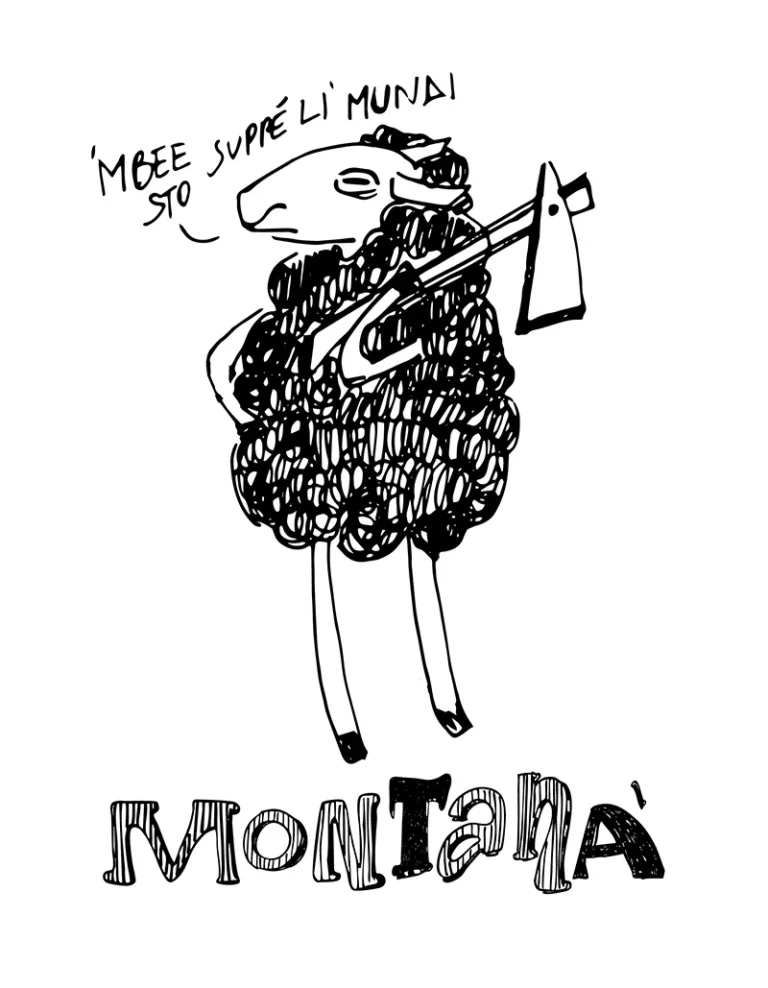
He doesn’t just climb the mountains: he conquers them, throws a party on top… and you’re not invited. He symbolizes everyday resilience, a territory that doesn’t bend and teaches toughness as an art form.
The mountain as a cultural laboratory
The Montanà lives in a context that is both physical and cultural. The Sibillini are not just mountains: they are stages, challenges, places where language, daily gestures, and rituals become symbols of belonging and resilience. The Montanà teaches us that survival has its own grammar, made of community, irony, work, and historical memory. The mountain thus becomes a living anthropology lab: every stone tells the stories of those who climbed it, inhabited it, and built identities and traditions there.
Semiotics of toughness
The Montanà’s body and life are cultural signs. The rebel of the Sibillini represents the historical particularism of Franz Boas: a deep rooting in a specific territory, an identity shaped by harsh landscapes and events that test resilience. Toughness is not just physical: it’s linguistic, symbolic, and social. The Montanà communicates with gestures, glances, and local sayings, building a survival code that becomes a semiotics of the territory.
A ram between punk and Marchigian irony
Lu Montanà combines two seemingly opposite worlds: the hardest tradition and punk irreverence. He is tough, resilient, but knows how to laugh at himself and his own hardness. The summit parties, the games, the sharp dialect, and self-irony are tools of cultural survival: the Montanà shows us that resilience can also be a creative and joyful act. That’s why we represented him as a rebellious ram dancing among the boulders, defying gravity and conventions, and doing so in his own language.
Why the Montanà speaks to us today
Montanà is not just a local figure: he is a universal symbol of resilience, identity, and irony. Through his story, we understand how culture, territory, and semiotics intertwine in surprising ways. The Montanà invites us to look beyond the picturesque image of the mountain: behind the toughness lies a world of gestures, words, community, and creative rebellion. And if you want to join the party… well, get ready to climb your own mountains, because up there, the Montanà isn’t waiting for you.